
PLANT NUTRITION / READING THE LABEL
Three numbers. Start with their basis.
The N–P–K grade on a fertilizer tells you the guaranteed nutrient percentages in the product. It does not tell you how concentrated the final solution will be, how much is already in the soil or water, or which formula will work best for every cannabis plant. Learn to interpret the label first; then match nutrition to the growing medium and the plant’s needs.
01 / THE LABEL-READING BENCH
Turn the grade into something you can read.
Enter a fertilizer’s three percentages to unpack its proportions and approximate elemental content. This bench uses N–P₂O₅–K₂O percentages by weight. Check that your label uses that convention first.
Your guaranteed-analysis reading.
—
Label A · N–P₂O₅–K₂O, % by weight
| Element | Label basis | Elemental mass |
|---|---|---|
| N | ||
| P | ||
| K |
P and K use rounded conversion factors: phosphate × 0.44 and potash × 0.83. These are approximate amounts implied by the guaranteed percentages.
Enter your label, or try an example.
The grade does not reveal nutrient release, final solution concentration or how much your plant needs. Read the full product directions.
Method: CSU Extension on grades and ratios · Penn State’s elemental conversions.
02 / THE GUARANTEED ANALYSIS
What a 15–5–10 fertilizer label actually means
U.S. fertilizer grades typically state percentages by weight of total nitrogen (N), available phosphate (P₂O₅) and soluble potash (K₂O), in that order. The middle and last numbers use historical oxide equivalents—not percentages of elemental phosphorus and potassium.
Multiply the phosphate figure by 0.44 to estimate elemental phosphorus.
Multiply the potash figure by 0.83 to estimate elemental potassium.
Read the ratio separately: divide 15–5–10 by its smallest non-zero number, 5, to get 3 : 1 : 2. A 4–2–4 and a 20–10–20 both reduce to 2 : 1 : 2; per equal product mass, their guaranteed percentages differ fivefold. A zero entry remains zero.
These are conversions for understanding guaranteed analysis. They are not the nutrient concentrations that roots receive after dilution. See Colorado State University Extension and Penn State Extension.
03 / WHAT EACH ELEMENT DOES
Plants use all three across their entire life.
Builds new growth
Nitrogen supports chlorophyll, amino acids and the production of leaves and shoots. Demand is often substantial during vigorous vegetative growth, but flowering plants still need nitrogen.
Powers cell processes
Phosphorus is part of ATP and genetic material and is involved in root and reproductive development. More phosphate does not automatically mean bigger flowers.
Regulates water use
Potassium supports stomatal control, osmoregulation and many enzymes. Adequate supply matters; excessive potassium can interfere with nutrient balance.
04 / THE LIFE CYCLE
Follow changing demand through the life cycle.
A cannabis plant’s life cycle changes how it allocates resources. A stage label alone cannot set a precise formula: genetics, medium, water chemistry and the existing nutrient reserve all matter.
For a practical, stage-by-stage decision framework rather than the meaning of the three label numbers, see choosing an NPK program for vegetative and flowering growth.
Seedling establishment
New roots and leaves need an appropriate, not overly concentrated nutrient supply. Many prepared media already contain starter fertility.
Seedling guide →Vegetative growth
Rapid leaf and stem production typically makes nitrogen especially important. A complete fertilizer and the existing growing medium remain the starting points.
Vegetative guide →Flowering
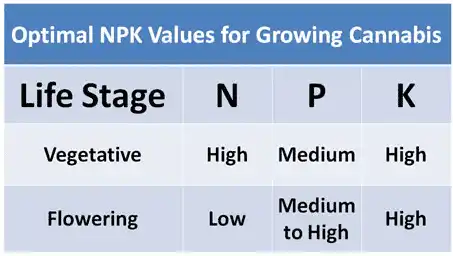
Nitrogen demand often changes relative to other elements, but it does not disappear. Avoid assuming that very high phosphorus or potassium must improve yield; see the flower-development reference for more context.
Flowering guide →One controlled deep-water-culture study of a single cultivar found an inflorescence-yield response to nitrogen and phosphorus concentrations, but no potassium response within its tested range. Its calculated values are not a universal recipe for every cultivar or growing system.
Read the research →05 / BEFORE BUYING A BOTTLE
Read the complete nutrient program.
Compare actual strength. A 4–2–4 and 20–10–20 share the same N–P–K proportion, but not the same concentration by weight. Dosing determines what reaches the container.
Check what else is supplied. Calcium, magnesium, sulfur and micronutrients can appear elsewhere on the guaranteed analysis or come from another component or the medium.
Read the mixing instructions. “Part A” and “Part B” typically identify separate concentrated components kept apart for chemical compatibility; they do not automatically mean “vegetative” and “flowering.”
Diagnose before adjusting. pH, root function, concentration and water quality affect uptake. Leaf color alone cannot tell you which fertilizer ratio to purchase.
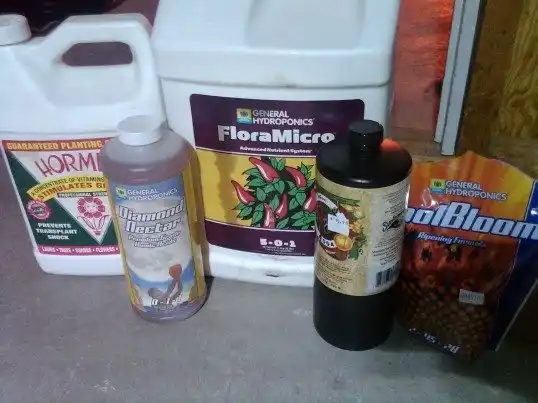
For growing-medium context, use the nutrient guide, pH reference, electrical conductivity and leaf troubleshooting. For product examples, see the FoxFarm reference; label details can change, so verify current packaging. Browse hydroponic systems or the wider growing library for method-specific context.
FROM REAL FERTILIZER PACKAGING
Look beyond the three big numbers.
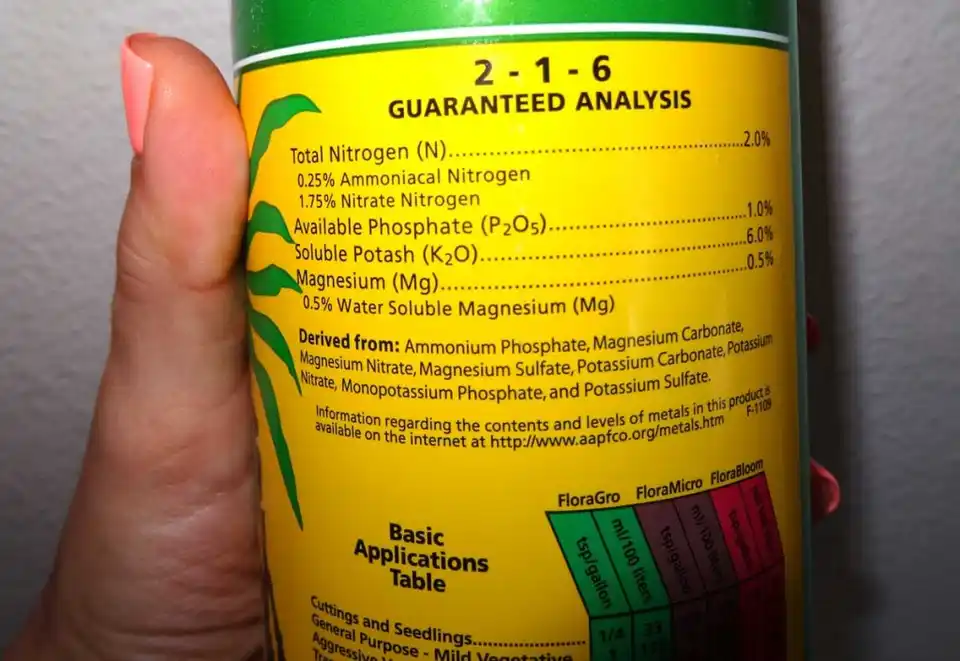
On an actual container, the detailed analysis shows forms of nitrogen and may list secondary elements such as magnesium. Product-specific application tables also require careful reading. They are not a substitute for a complete, medium-appropriate feeding plan.
06 / AT THE LABEL
Make sense of the fine print.
Is 20–10–20 the same as 4–2–4?
Both have a 2 : 1 : 2 ratio on the N–P₂O₅–K₂O label basis. Per equal mass of product, 20–10–20 guarantees five times each listed percentage. Sources, release rate, additional nutrients and directions can still differ. A matching ratio does not make products interchangeable.
Why is the middle number not elemental phosphorus?
The label convention expresses available phosphate as a P₂O₅ equivalent. Multiply that percentage by about 0.44 to express it as elemental P. For potash expressed as K₂O, multiply by about 0.83 to express elemental K. These conversions change the reporting basis, not the product.
Can I enter millilitres instead of grams?
The bench uses percentages by weight and a product mass in grams. Converting liquid volume to mass requires that product’s density. Do not assume 1 mL weighs 1 g.
Are the remaining percentages just filler?
The three-number grade does not describe everything in the product. Other elements and compounds can account for mass, including secondary nutrients. The oxide-equivalent figures are also a reporting convention. Read the complete analysis instead of treating the unlisted balance as a measure of filler or quality.
Further reading
CSU Extension: Understanding Fertilizers · University of Saskatchewan: Cannabis · Bevan et al., 2021: Cannabis NPK response
CONTINUE LEARNING